
Principal’s Welcome

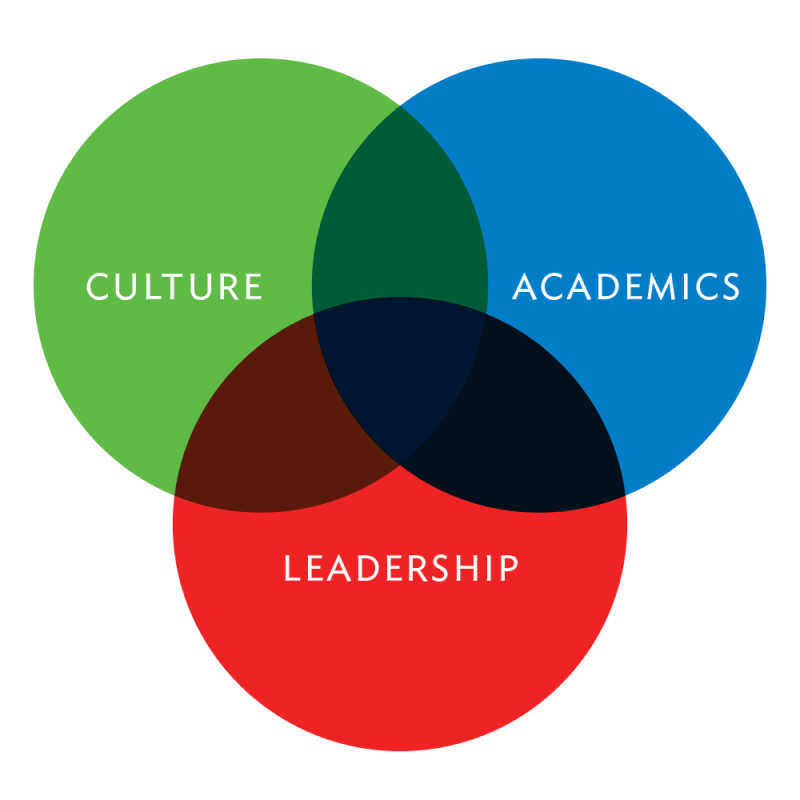
Leadership is the umbrella term to encompass the many character traits and basic life competencies that parents, business leaders, and educators are voicing as the desired skills necessary to thrive in the 21st century. Leadership is a concept we don’t normally consider when thinking of young children. However, young children are very capable of learning leadership skills and using them at home and at school. By developing well-rounded children who know their strengths, we help them to unleash their potential to lead their own lives and to influence others. Read more
    NAPLAN & Attitudes to Schools Survey 
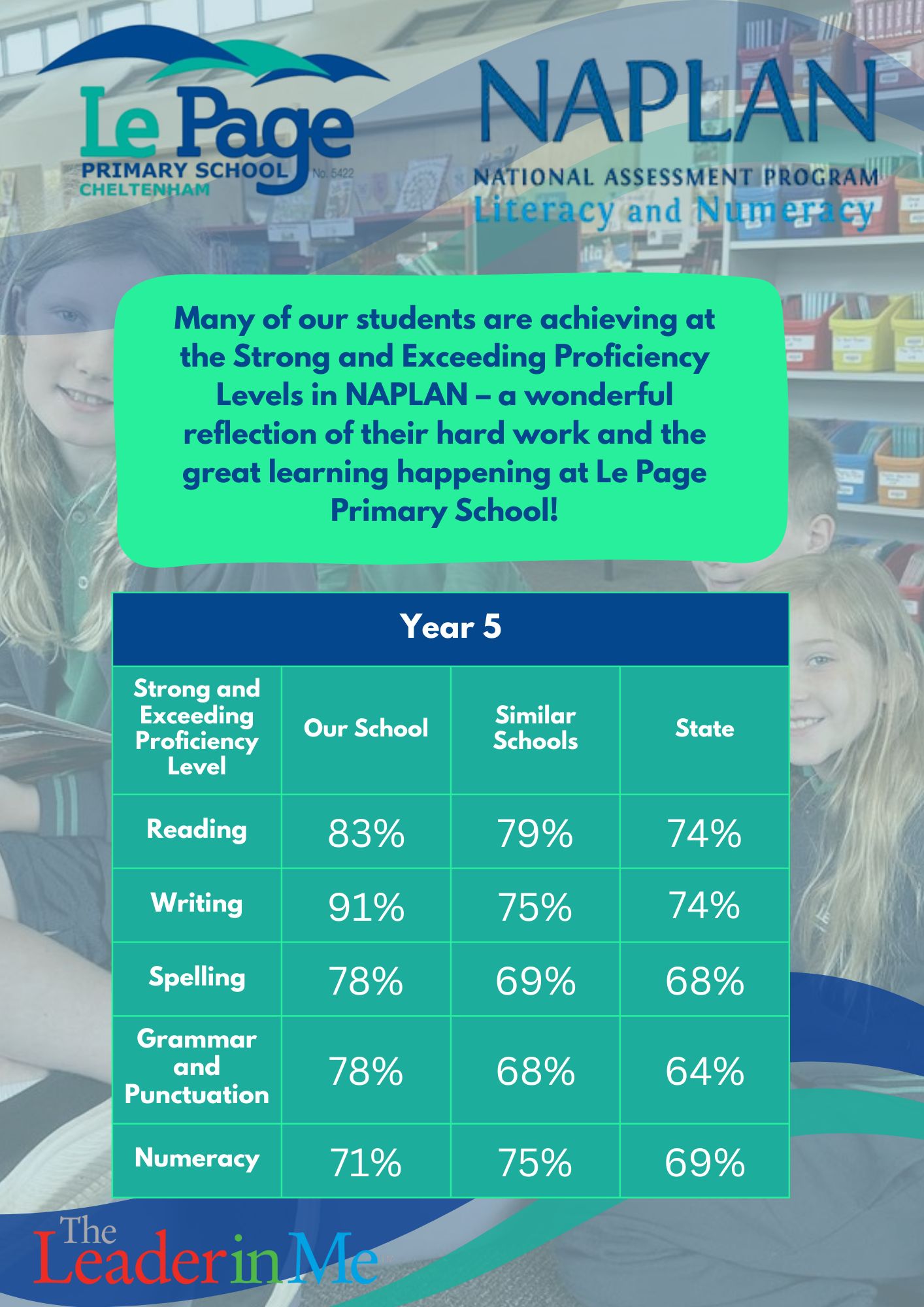
Celebrating Student Success at Le Page 

Le Page Primary School – 2025 NAPLAN & Attitudes to School Survey Results

Our Vision
A prosperous path for every child. Each journey is theirs to lead. There is a place in which every child can shine.

Our Mission
To identify the talent, develop the confidence, and create the leader.

Our students’ responses to the Attitudes to School Survey are a true indicator of how well we are achieving our vision and mission. We are thrilled to share our 2025 results, which highlight the strong sense of belonging, confidence, and engagement felt by our students.

Alongside our positive NAPLAN results, these outcomes reflect the dedication of our staff, students, and families in creating a school where every child can thrive.

Latest News

Comments Box SVG iconsUsed for the like, share, comment, and reaction icons

🎨 Foundation 2026 Transition – Art Day! 🐠
Our future Foundation students had a fantastic morning with Mrs Bradley for our Art Day transition session! The children created beautiful rainbow fish puppets using paper plates and colourful crepe paper — so much creativity and joy! 🌈✨
They also loved spending time on the playground, making new friends, and exploring their new school environment. 🛝💛
It’s been a bright, fun-filled morning and we can’t wait to see more amazing artwork when our newest learners join us in 2026! 🎉
... See MoreSee Less

🎨 Foundation 2026 Transition – Art Day! 🐠
Our future Foundation students had a fantastic morning with Mrs Bradley for our Art Day transition session! The children created beautiful rainbow fish puppets using paper plates and colourful crepe paper — so much creativity and joy! 🌈✨
They also loved spending time on the playground, making new friends, and exploring their new school environment. 🛝💛
It’s been a bright, fun-filled morning and we can’t wait to see more amazing artwork when our newest learners join us in 2026! 🎉Image attachmentImage attachment+Image attachment

Foundation Maths 🧮

In Maths, we’ve recently wrapped up our learning on positional language, using lots of hands-on activities to describe where objects are and how they move. We’ve now moved on to showing and counting numbers on a grid, which has been both fun and challenging! The children especially enjoyed playing board games like Snakes and Ladders, which helped them practise counting, number recognition, and turn-taking in a playful way.
... See MoreSee Less

Foundation Maths 🧮

In Maths, we’ve recently wrapped up our learning on positional language, using lots of hands-on activities to describe where objects are and how they move. We’ve now moved on to showing and counting numbers on a grid, which has been both fun and challenging! The children especially enjoyed playing board games like Snakes and Ladders, which helped them practise counting, number recognition, and turn-taking in a playful way.Image attachmentImage attachment+5Image attachment

Our Year 1s having a great time playing Chess during lunch breaks ... See MoreSee Less

Our Year 1s having a great time playing Chess during lunch breaksImage attachment

We are so proud of our Leaders here at Le Page PS.
Today Daniel our school captain wrote and read the following to our school for Remembrance Day.

Lest we forget

❤️❤️❤️❤️❤️❤️❤️❤️❤️❤️❤️❤️❤️❤️❤️

Hello everyone, I’m Daniel- one of LePage’s school captains. Please make sure you are seated and ready to listen for remembrance day.

We stand here this morning on Bunurong land. We acknowledge the Traditional Owners of the Country that we are on, and recognise their continuing connection to land, waters and culture. We pay our respect to Elders past and present.
The First World War was in its time the most destructive conflict yet experienced by humanity. When it began in August 1914, few imagined the course that it would take, or foresaw its terrible toll. From a population of just under 5 million, more than four hundred thousand Australians enlisted in the Australian Imperial Force – the AIF, the force that Australia sent to the war – and more than three hundred and thirty thousand served overseas. For most this meant Gallipoli, the Middle East or the war's main theatre: the Western Front in France and Belgium. More than sixty thousand Australians lost their lives, a devastating toll for a small country. Yet they were a relative few.
Around the world some 10 million military personnel died in what was then called the Great War. Families and communities everywhere were affected by the enormous loss. When an armistice ended the fighting on 11 November 1918, celebrations in the victorious nations were tempered by grief and sorrow. In Britain and the countries of her empire, the day's anniversary became known as Armistice Day.
In 1919 and in every year since at 11 am on 11 November, people have paused to remember the dead. So great had been the loss of life, so devastating had been the destruction, that people hoped, even imagined, that the Great War would be the last war, ‘the war to end war'. But it was not to be. Two decades after the First World War ended, the world was plunged into a second global conflict. No longer could Armistice Day remain a day only to remember the dead of the First World War.
After the Second World War ended in 1945, 11 November became known as Remembrance Day. The day's sombre associations have never changed. When we pause at 11 am on 11 November, we reflect on the price that Australia and countries around the world have paid through more than a century of war and conflict that followed the First World War.
We will now have a minute's silence to reflect and pay respect to those who have lost
their lives during times of war.

Thank you everyone for demonstrating respect during this time.
... See MoreSee Less

We are so proud of our Leaders here at Le Page PS. 
Today Daniel our school captain wrote and read the following to our school for Remembrance Day. 

Lest we forget

❤️❤️❤️❤️❤️❤️❤️❤️❤️❤️❤️❤️❤️❤️❤️

Hello everyone, I’m Daniel- one of LePage’s school captains. Please make sure you are seated and ready to listen for remembrance day. 

We stand here this morning on Bunurong land. We acknowledge the Traditional Owners of the Country that we are on, and recognise their continuing connection to land, waters and culture. We pay our respect to Elders past and present.
The First World War was in its time the most destructive conflict yet experienced by humanity. When it began in August 1914, few imagined the course that it would take, or foresaw its terrible toll. From a population of just under 5 million, more than four hundred thousand Australians enlisted in the Australian Imperial Force – the AIF, the force that Australia sent to the war – and more than three hundred and thirty thousand served overseas. For most this meant Gallipoli, the Middle East or the wars main theatre: the Western Front in France and Belgium. More than sixty thousand Australians lost their lives, a devastating toll for a small country. Yet they were a relative few.
Around the world some 10 million military personnel died in what was then called the Great War. Families and communities everywhere were affected by the enormous loss. When an armistice ended the fighting on 11 November 1918, celebrations in the victorious nations were tempered by grief and sorrow. In Britain and the countries of her empire, the days anniversary became known as Armistice Day. 
In 1919 and in every year since at 11 am on 11 November, people have paused to remember the dead. So great had been the loss of life, so devastating had been the destruction, that people hoped, even imagined, that the Great War would be the last war, ‘the war to end war. But it was not to be. Two decades after the First World War ended, the world was plunged into a second global conflict. No longer could Armistice Day remain a day only to remember the dead of the First World War. 
After the Second World War ended in 1945, 11 November became known as Remembrance Day. The days sombre associations have never changed. When we pause at 11 am on 11 November, we reflect on the price that Australia and countries around the world have paid through more than a century of war and conflict that followed the First World War.
We will now have a minutes silence to reflect and pay respect to those who have lost
 their lives during times of war.

Thank you everyone for demonstrating respect during this time.Image attachment
Load more

Communicate with your child’s teacher, view schedules and keep track of homework. Compass is an all-in-one school management system designed to improve your child’s learning outcomes, drive in-school efficiency and enable more communication in your school community. Please contact the front office if you need any assistance with Compass.